<?xml version="1.0" encoding="utf-8"?><feed xmlns="http://www.w3.org/2005/Atom">
  <generator uri="https://jekyllrb.com/" version="3.10.0">Jekyll</generator>
  <link href="https://henkwww.github.io/feed.xml" rel="self" type="application/atom+xml" />
  <link href="https://henkwww.github.io/" rel="alternate" type="text/html" />
  <updated>2026-10-17T21:00:00+02:00</updated>
  <id>https://henkwww.github.io/feed.xml</id>
  <title type="html">HenkWWW</title>
  <subtitle>Penetration testing writeups, Active Directory attack notes and cheatsheets by an operational sysadmin turned offensive security practitioner. HTB CPTS certified.</subtitle>
  <author><name>Henk Wichers</name></author>
  <entry xml:lang="en">
    <title type="html">Prevention is better than cure</title>
    <link href="https://henkwww.github.io/blog/2026/10/prevention-beats-cure/" rel="alternate" type="text/html" title="Prevention is better than cure" />
    <published>2026-10-17T21:00:00+02:00</published>
    <updated>2026-10-17T21:00:00+02:00</updated>
    <id>https://henkwww.github.io/blog/2026/10/prevention-beats-cure</id>
    <content type="html" xml:base="https://henkwww.github.io/blog/2026/10/prevention-beats-cure/"><![CDATA[<p>As a sysadmin I sometimes hear from people that they’ve been hacked. Afterwards they suddenly want to know how they could have prevented it. Almost always it is the same mistake.</p>

<p>One password for everything. And no two-factor authentication anywhere.</p>

<p>That isn’t stupidity, it’s convenience. Better security is usually less user-friendly, and that is where it goes wrong.</p>

<p>Below are ten things you can do. If you only do one, do the first one and set up a password manager today. That takes care of most of the risk.</p>

<p><img src="/assets/img/blog/voorkomen-is-beter-dan-genezen/staysafe.jpg" alt="Henk sitting on a giant golden padlock swinging like a swing, wearing a &quot;Stay safe&quot; hoodie" />
<em>Half an hour of work takes most of it away.</em></p>

<h2 id="10-security-tips-for-your-accounts">10 security tips for your accounts</h2>

<h3 id="1-always-use-2fa-or-mfa">1. Always use 2FA or MFA</h3>

<p>Especially on your email accounts. The worst part of being hacked is losing access to your own email. Use an app or a passkey instead of SMS, because SMS can be intercepted. Keep your recovery codes somewhere you can find them. MFA is a hassle. Hackers think so too.</p>

<h3 id="2-your-phone-is-a-computer-as-well">2. Your phone is a computer as well</h3>

<p>Only install the apps you actually need, from the official app store, and check which permissions they ask for.</p>

<h3 id="3-always-update">3. Always update</h3>

<p>Better still: turn automatic updates on, then you don’t have to think about it. Hackers use the newest vulnerabilities, and with AI that moves very fast.</p>

<h3 id="4-use-a-passphrase">4. Use a passphrase</h3>

<p>At least three or four random words. Length helps more than symbols: <code class="language-plaintext highlighter-rouge">bike-lamp-train-bread</code> is much harder to crack than <code class="language-plaintext highlighter-rouge">Bloempot123!</code>. Hackers work from lists with billions of passwords from earlier data breaches.</p>

<h3 id="5-dont-use-the-same-password-everywhere">5. Don’t use the same password everywhere</h3>

<p>Say a webshop gets hacked and <code class="language-plaintext highlighter-rouge">pietje@hotmail.com</code> with the password <code class="language-plaintext highlighter-rouge">Bloempot123!</code> ends up on a list. What do you think the next step is? Check on <a href="https://haveibeenpwned.com/">haveibeenpwned.com</a> whether your address shows up in a breach, and change that password straight away.</p>

<h3 id="6-use-a-password-manager">6. Use a password manager</h3>

<p>“Easy for you to say, I’ll never remember that.” That is what a password manager is for, such as Bitwarden or 1Password. It generates strong passwords and you only have to remember one. So not a Word document. I see those.</p>

<h3 id="7-dont-use-outdated-software">7. Don’t use outdated software</h3>

<p>Windows 10 has had no updates since October 2025, and an iPhone that no longer receives updates has the same problem. Old and unpatched is wide open.</p>

<h3 id="8-make-a-backup-your-computer-cant-reach">8. Make a backup your computer can’t reach</h3>

<p>An external drive you disconnect after copying, or a cloud service. And test whether you can actually restore it. With ransomware, this is the difference between a bad week and losing everything.</p>

<h3 id="9-hacked-get-it-off-the-internet">9. Hacked? Get it off the internet</h3>

<p>Network cable out, wifi off. Then change your passwords from a device that is definitely clean, starting with your email. If bank details are involved, call your bank immediately. And call someone who knows about this.</p>

<h3 id="10-never-click-a-link-in-an-email-or-text-message">10. Never click a link in an email or text message</h3>

<p>Not even if it looks genuine. Go to your bank’s website yourself. A few years ago a spelling mistake gave phishing away; with AI that signal is gone. Look at the real domain behind the sender, not the name shown. Messages like “Someone in Russia is trying to log in, was that you?” can be fake too. And watch the search results: search for “deepseek” and the top results can be ads or fake sites. Type the address yourself or use a bookmark.</p>

<p>And if you’re thinking this is a lot: start with tip 1 and tip 6. That’s half an hour of work together, and it takes away most of it.</p>
]]></content>
  </entry>
  <entry xml:lang="en">
    <title type="html">You&apos;re not the customer, you&apos;re the product</title>
    <link href="https://henkwww.github.io/blog/2026/10/privacy/" rel="alternate" type="text/html" title="You&apos;re not the customer, you&apos;re the product" />
    <published>2026-10-17T20:00:00+02:00</published>
    <updated>2026-10-17T20:00:00+02:00</updated>
    <id>https://henkwww.github.io/blog/2026/10/privacy</id>
    <content type="html" xml:base="https://henkwww.github.io/blog/2026/10/privacy/"><![CDATA[<p>Do you recognise this? You talked about something, and a little later you get ads about exactly that subject. It happens to all of us.</p>

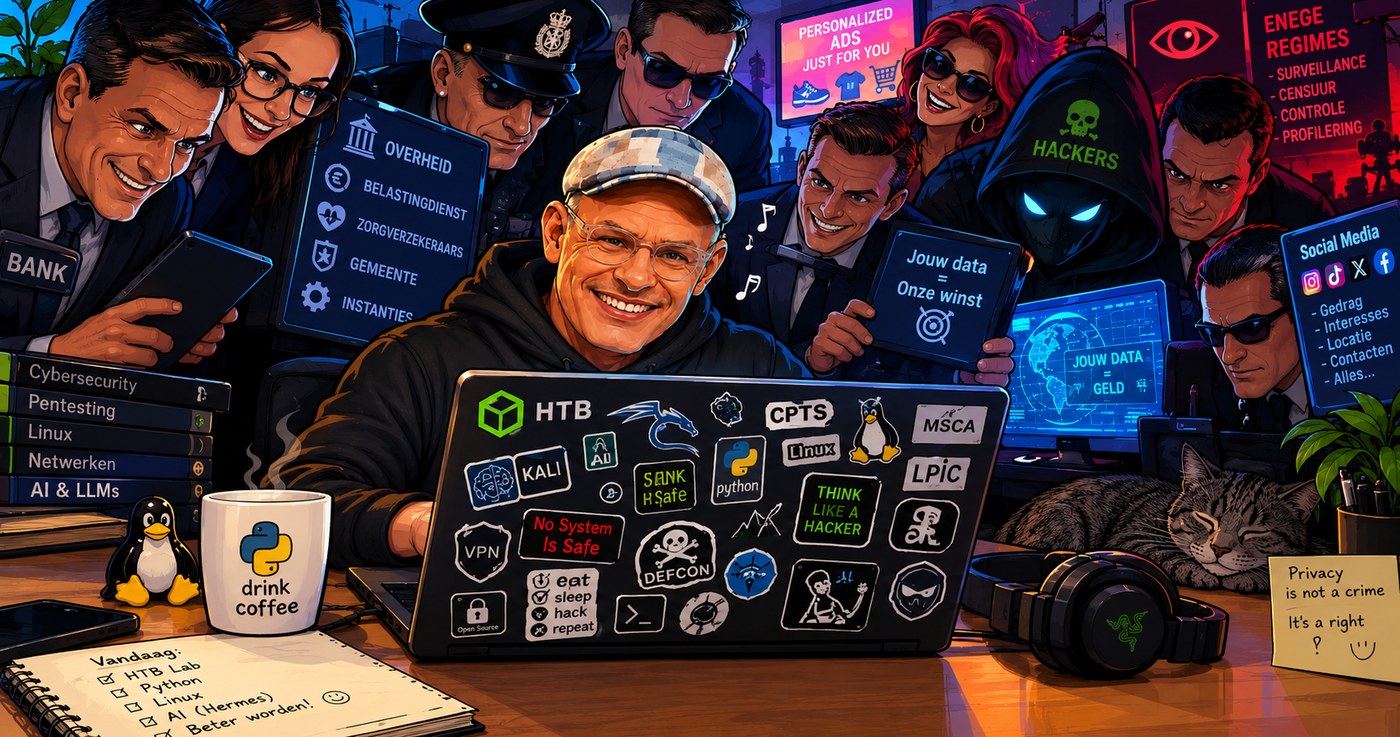
<p><img src="/assets/img/blog/privacy/privacy-illustratie.jpg" alt="Henk behind a laptop covered in security stickers, surrounded by a banker, the government, a police officer, a hacker and social media" />
<em>They all want a piece of your data.</em></p>

<p>It feels like your phone is listening, and sometimes it is: voice assistants sit waiting for their trigger word all day, and there are recordings that were listened to by people. But there’s more going on. It knows where you are, what you read, and who sits in the same advertising audience as you.</p>

<p>All of this looks fairly harmless. Internet services like social media and AI, which seem to be free, come with a price tag. You pay with your privacy.</p>

<p>Now you’re probably thinking: “What does it matter? I’m an ordinary Dutchman with nothing to hide.” That’s an understandable thought.</p>

<p>The customers of social platforms are advertisers: companies, political parties, and other parties with money and a message.</p>

<p>You’re not the customer, you’re the product. In the Cambridge Analytica case, the data of millions of Facebook users was used for political advertising.</p>

<p>Imagine this: you’re scrolling endlessly through your feed and you linger on an article about asylum seekers who are supposedly turning things upside down. That is valuable data. Plenty of parties have an interest in polarisation, such as:</p>

<ul>
  <li>the platform’s own algorithm</li>
  <li>Russia</li>
</ul>

<p>With today’s AI technology you can target an audience very precisely. That is how you end up in a filter bubble, with conspiracy theories lying in wait. “Don’t you find it annoying too, that asylum seekers are looting the shopping centre?” Almost nobody says no to that question. Mind you: that is a frame you are being served, not a description of your own neighbourhood.</p>

<p>This isn’t about left or right for me, but about what polarisation does. It applies to the left as well as the right of the political spectrum.</p>

<p>A divided Europe is a dream scenario for Russia and China. The United States historically had an interest in a strong Europe against Russia, but there is little left of that. This month Trump struck a diesel deal with Putin and suspended the sanctions on Russian diesel, asked Ukraine to stop attacking Russian refineries, and said Kyiv should elect a new leader. It looks like Washington doesn’t want a strong Europe at all. As far as I’m concerned, a divided Europe mainly serves the parties that don’t want a strong opponent. After all, when two dogs fight over a bone, the third one walks off with it.</p>

<p>Check your privacy settings and don’t share more than you need to. But know that this is the least you can do: the tracking that remains is invisible, and you can’t switch it off. What does help is fewer platforms, no Meta app on your phone, and a browser with an ad blocker. Awareness is the most important thing. The rest is weighing up how much convenience you’re willing to trade for it. You can’t avoid AI and internet services anymore. Not even I can.</p>
]]></content>
  </entry>
  <entry xml:lang="en">
    <title type="html">Avatar</title>
    <link href="https://henkwww.github.io/blog/2026/10/avatar/" rel="alternate" type="text/html" title="Avatar" />
    <published>2026-10-17T09:00:00+02:00</published>
    <updated>2026-10-17T09:00:00+02:00</updated>
    <id>https://henkwww.github.io/blog/2026/10/avatar</id>
    <content type="html" xml:base="https://henkwww.github.io/blog/2026/10/avatar/"><![CDATA[<p>On Discord and on my Hack The Box profile I use this avatar.</p>

<p><img src="/assets/img/blog/avatar/henkwww.png" alt="The little pig I use as my avatar" width="163" />
<em>The pig, drawn by me in Inkscape.</em></p>

<p>Great fun, of course: a meaningless little pig.</p>

<h2 id="but">But…</h2>

<p>Besides hacking and tinkering, I really like drawing. I drew the pig myself in Inkscape: it didn’t come off the internet and it wasn’t generated with AI.</p>

<h2 id="why">Why…</h2>

<p>Why a pig? Well, like this. Holten, the village where I live, grew big on the pig farmers who settled there. The old coat of arms of Holten carries three boar heads. In the local dialect a piglet is called a <em>keun</em>.</p>

<p><img src="/assets/img/blog/avatar/holten-wapen.svg" alt="The coat of arms of Holten" width="200" />
<em>The coat of arms of Holten, with the three boar heads on the right.</em></p>

<p>At carnival, Holten is called Keunedarp. And every year there are the Keunefeesten.</p>

<p>The slaughterhouses and meat processors that used to be here come from the same roots. I started my IT career at the meat processor Enkco. Among other things they ran a vegetarian line, Vivera, which later went independent. Today I’ve been working there for 30 years.</p>

<p>Holten has no meat industry left today.</p>

<p>Salland and the Achterhoek are full of legends. One of them is the Low Saxon story of <em>Derk met den bear</em>. A lot of traditions in the region trace back to it, such as the notorious <em>slepp’n</em> in Markelo.</p>

<p>The short version of the story goes like this.</p>

<p>Derk, a farmer, comes into his barn one day and finds all his cattle dead. He got so angry at what God had done to him that he grabbed his air rifle and, cursing and raving, fired into the sky at God. As punishment, Derk had to hunt a pig for all eternity in the afterlife.</p>

<p>On Christmas Eve people say you should bring everything of value inside. Because Derk met den bear comes past like a storm and shoots at anything that isn’t nailed down.</p>

<p>So the little pig stands for my roots. From a small village in Salland you don’t always count. Research shows that people with a Twente accent are seen as less intelligent, and for various communication roles there are courses to unlearn your accent.</p>

<p>I’m proud to come from Salland. Hence the pig.</p>
]]></content>
  </entry>
  <entry xml:lang="en">
    <title type="html">Passing the CPTS when your skills aren&apos;t the problem</title>
    <link href="https://henkwww.github.io/blog/2026/05/cpts-when-skills-arent-the-problem/" rel="alternate" type="text/html" title="Passing the CPTS when your skills aren&apos;t the problem" />
    <published>2026-05-30T00:00:00+02:00</published>
    <updated>2026-05-30T00:00:00+02:00</updated>
    <id>https://henkwww.github.io/blog/2026/05/cpts-when-skills-arent-the-problem</id>
    <content type="html" xml:base="https://henkwww.github.io/blog/2026/05/cpts-when-skills-arent-the-problem/"><![CDATA[<p>I’m 53 years old, 27 of them as a sysadmin, and I’ve been on Hack The Box
regularly since 2024. To keep from getting stuck in the daily grind at
work, I started on the CPTS path in 2025. I finished it in 2026, certificate
and all. It took me two attempts. On the second attempt I had all 14
flags, while 12 would have been enough.</p>

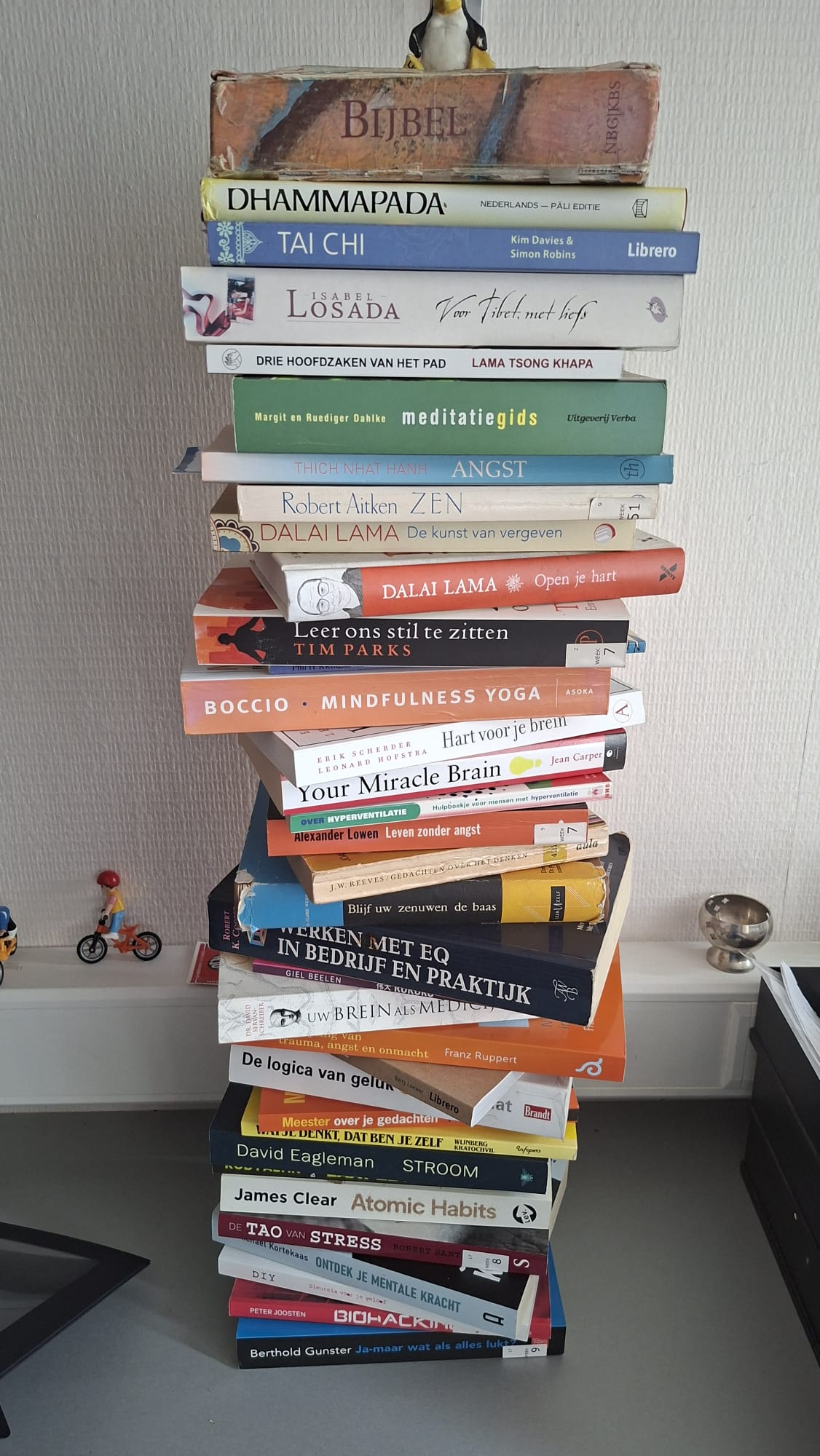
<p><img src="/assets/img/blog/cpts-when-skills-arent-the-problem/self-help-books.jpg" alt="Stack of self-help books on a shelf" />
<em>Plenty of wisdom here — the question is where you put your attention.</em></p>

<p>I’ve had an anxiety disorder all my life. It fades sometimes, and
sometimes I get panic symptoms. That’s bad news in stressful situations:
it dampens your ability to think straight and to put things in
perspective. Stressful situations like exams and certifications you end
up walking away from instead of taking them on.</p>

<p>I wrote this blog for hackers with mental challenges like mine, to avoid
a few pitfalls.</p>

<p>You can do what I did: buy a stack of self-help books, put them on the
shelf, and keep going over and over what could go wrong. Reading those
books doesn’t really help if you don’t do it interactively. Or if you
don’t have the right mindset. As Johan Cruyff said: “You only see it
when you get it.” Sometimes it just doesn’t work, because of stress or
other circumstances around you.</p>

<p>What certainly doesn’t help is keeping your focus on the problem itself.
Put your attention on the things you actually enjoy instead. For me, and
probably for you, that’s hacking. :)</p>

<p>There are plenty of blogs about how to prepare for CPTS and how to write
the report. Most are by people who are built differently than I am. I’m
not a hip young confident vlogger, and my information needs are different.</p>

<p>Online you read a lot about how hard the CPTS is and how many people
fail on the report. If you have a tendency to doubt yourself, or you get
stage fright, that can be the trigger never to start.</p>

<p>So here’s my story and my pitfalls. I hope it’s of some use to you.</p>

<h2 id="how-it-went-for-me">How it went for me</h2>

<p>I was nervous as hell when I started the exam and went at it like a
maniac. I began enumerating frantically and jumped from one thing to the
next. I gave myself few moments to put things in perspective.</p>

<p>The first night I slept poorly. The moment I got out of bed I carried
on. The pace was fine, though. The second night I slept even worse. And
on day 3 I had tunnel vision and dug myself deep into a rabbit hole.</p>

<p>Instead of taking a step back, I pushed harder. When time started
running out, the panic kicked in. The result: you can no longer put
anything in perspective. Staying calm is key.</p>

<p>Because you’re so bent on the flags, it sometimes comes at the expense
of the documentation. You do have to keep track of your chain, because
you’ll have to redo it at some point.</p>

<p>In the end I found that for me it wasn’t a skill issue at all; it was my
behaviour that did me in. Enumerating from panic, no structure, refusing
to sleep, not recovering from a bad first lead. Beyond that I think 10
days is quite short; writing a report takes real time too.</p>

<p>If you recognise that pattern, I have a few tips.</p>

<h2 id="mindset">Mindset</h2>

<p>A few things to internalise before you click <em>start</em>:</p>

<ol>
  <li><strong>You have a second attempt.</strong> Effectively that’s 20 days, not 10.
The clock isn’t as tight as it feels.</li>
  <li><strong>Submit a report on your first attempt no matter what.</strong> Even if you
don’t have all the flags. Otherwise you don’t get a retake.</li>
  <li><strong>Writing the report takes real time.</strong> A few days, not a few hours.
Build that into your schedule, not as an afterthought.</li>
  <li><strong>Stay close to the course material.</strong> Exotic chains outside what HTB
Academy covers are unlikely. Trust the syllabus.</li>
  <li><strong>Keep breathing.</strong> Calmly. Out loud if you need to. Panic mode is
not where you do good analysis.</li>
  <li><strong>Go for a run or a walk.</strong></li>
</ol>

<p>Do the things that give you rest. In panic you can’t do good analysis.
Sleep deprivation does the same. Don’t start the exam like a maniac.
Read what’s actually being asked first.</p>

<h2 id="what-helped-me">What helped me</h2>

<p><strong>Practise the report before the exam.</strong> Before you start on CPTS, write
a couple of mock reports in SysReptor based on retired HTB boxes. You’ll
get the structure into your muscle memory and discover how long it takes
when there’s no pressure on the clock. Read other CPTS students’ blog
posts, especially the ones about what the report needs to contain. That
knowledge is portable: during the engagement you use it to pre-fill
sections as you go.</p>

<p><strong>Document the chain as you build it.</strong> At every step, not just the
successful ones: write down what you tried, what worked, what didn’t,
and the relevant CVE or CWE. Take screenshots of the moments that
matter. Don’t tell yourself you’ll remember; under stress, you won’t. It
costs you a few minutes during the work and saves you hours on the
report.</p>

<p><strong>After the flags, walk it again as a layperson.</strong> Once you have all the
flags, go back through your chain step by step as if you were explaining
it to someone who wasn’t there. There should be no gaps. For each step,
ask: what CWE underlies this?</p>

<h2 id="if-youre-a-sysadmin-use-it">If you’re a sysadmin, use it</h2>

<p>Don’t be shy about bringing your operational background into the
report. If you’ve spent years running the infrastructure you’re now
breaking into, you have a perspective most pentesters don’t: you know
how the defenders will respond to your recommendations, what’s realistic
to implement, and what would actually have caught the chain in
production. That makes your remediation advice more grounded than a
textbook recommendation. Put it in the report.</p>

<h2 id="closing">Closing</h2>

<p>You don’t have to be a hip young hacker to do this. The exam asks for
technical skills and a coherent report. Beyond that, it takes time.</p>

<p>You miss every shot you don’t take.</p>

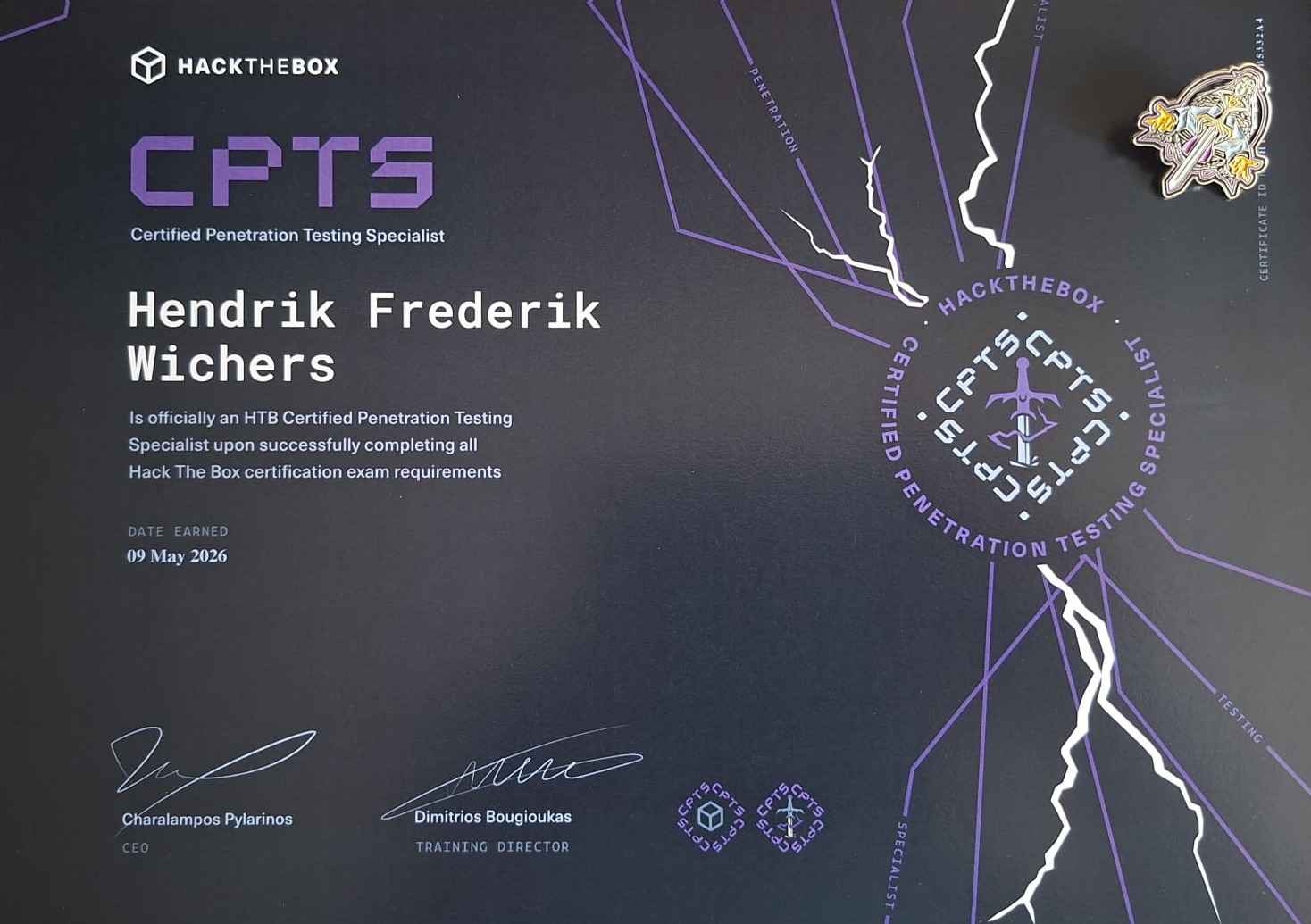
<p><img src="/assets/img/blog/cpts-when-skills-arent-the-problem/certificate.jpg" alt="CPTS certificate" />
<em>Second attempt — 14 of 14.</em></p>
]]></content>
  </entry>
</feed>