You're not the customer, you're the product
Do you recognise this? You talked about something, and a little later you get ads about exactly that subject. It happens to all of us.
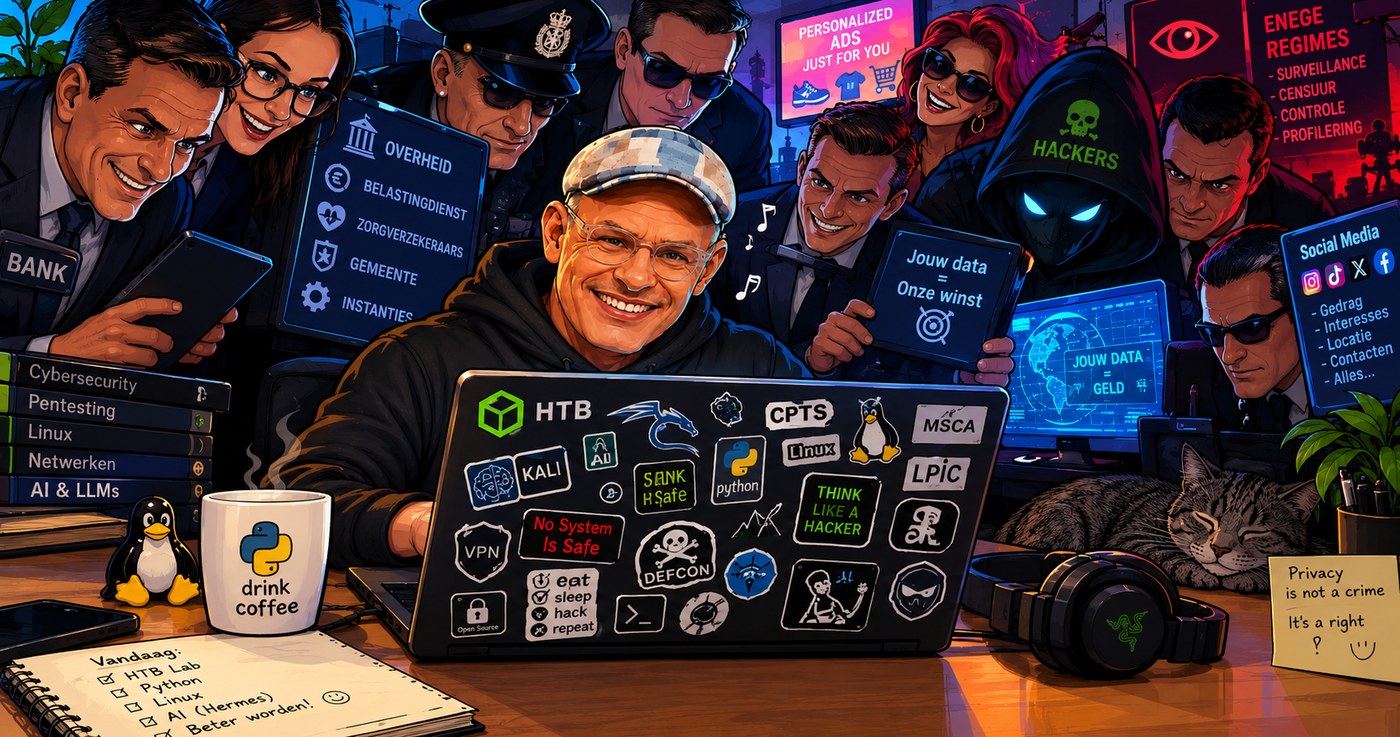 They all want a piece of your data.
It feels like your phone is listening, and sometimes it is: voice assistants sit waiting for their trigger word all day, and there are recordings that were listened to by people. But there’s more going on. It knows where you are, what you read, and who sits in the same advertising audience as you.
All of this looks fairly harmless. Internet services like social media and AI, which seem to be free, come with a price tag. You pay with your privacy.
Now you’re probably thinking: “What does it matter? I’m an ordinary Dutchman with nothing to hide.” That’s an understandable thought.
The customers of social platforms are advertisers: companies, political parties, and other parties with money and a message.
You’re not the customer, you’re the product. In the Cambridge Analytica case, the data of millions of Facebook users was used for political advertising.
Imagine this: you’re scrolling endlessly through your feed and you linger on an article about asylum seekers who are supposedly turning things upside down. That is valuable data. Plenty of parties have an interest in polarisation, such as:
- the platform’s own algorithm
- Russia
With today’s AI technology you can target an audience very precisely. That is how you end up in a filter bubble, with conspiracy theories lying in wait. “Don’t you find it annoying too, that asylum seekers are looting the shopping centre?” Almost nobody says no to that question. Mind you: that is a frame you are being served, not a description of your own neighbourhood.
This isn’t about left or right for me, but about what polarisation does. It applies to the left as well as the right of the political spectrum.
A divided Europe is a dream scenario for Russia and China. The United States historically had an interest in a strong Europe against Russia, but there is little left of that. This month Trump struck a diesel deal with Putin and suspended the sanctions on Russian diesel, asked Ukraine to stop attacking Russian refineries, and said Kyiv should elect a new leader. It looks like Washington doesn’t want a strong Europe at all. As far as I’m concerned, a divided Europe mainly serves the parties that don’t want a strong opponent. After all, when two dogs fight over a bone, the third one walks off with it.
Check your privacy settings and don’t share more than you need to. But know that this is the least you can do: the tracking that remains is invisible, and you can’t switch it off. What does help is fewer platforms, no Meta app on your phone, and a browser with an ad blocker. Awareness is the most important thing. The rest is weighing up how much convenience you’re willing to trade for it. You can’t avoid AI and internet services anymore. Not even I can.